
+92306 3026 466
What Do You Need to Bring to Your NSW Driving Test? Everything You Need to Know
Book Your Lesson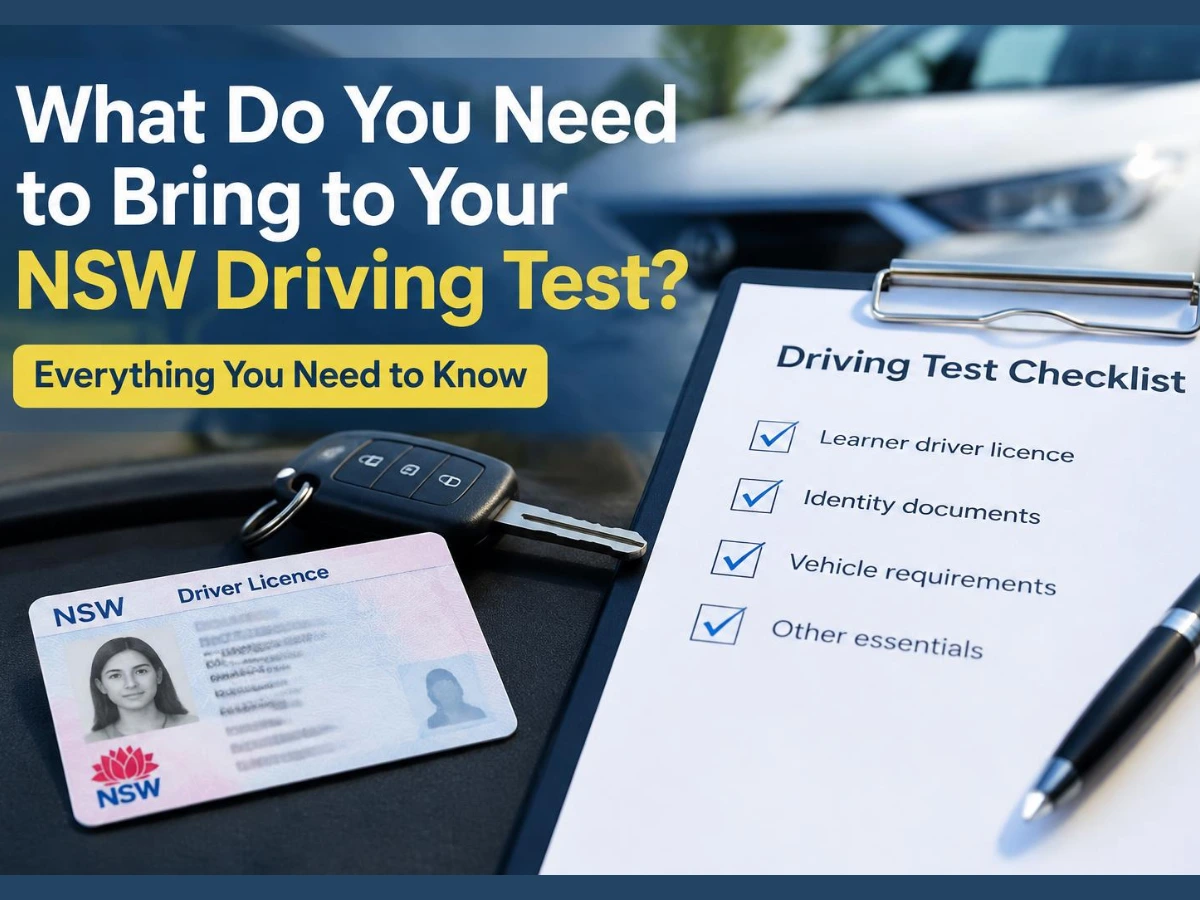
Your driving test is a significant milestone. It is the last step between you and becoming a licensed driver in New South Wales. Many learners spend months on driving lessons and practice, then lose marks on test day because they forgot a document or turned up in a car that was not roadworthy.
We wrote this comprehensive guide to stop that from happening. Below, we cover what you need to bring to your NSW driving test, how to prepare your car, what the testing officer checks, and how to stay calm. If you want a quick tick-list as well, we also keep a NSW driving test checklist for test day that you can save to your phone.
Quick Checklist: What to Bring to Your NSW Driving Test
We explain each item in the sections that follow.
- Your NSW learner licence (the photo card)
- Your completed logbook showing 120 hours, including 20 night hours
- Your booking confirmation from Service NSW
- A roadworthy, registered car with L plates on the front and back
- Your glasses or contact lenses, if your licence says you need them
- A supervising driver to travel with you to the test centre, if you are not driving there alone
- Water, and comfortable clothes and flat shoes
What Are the Requirements for a Driving Test in NSW?
Before you think about what to pack, check that you can sit the test at all. The NSW practical driving test has a few requirements. You must:
- Be at least 17 years old.
- Hold a learner licence, and for most drivers under 25, hold it for at least 10 months.
- Complete 120 hours of supervised driving in your logbook, including 20 hours at night.
- Pass the Driver Knowledge Test (DKT) to get your learner licence, and pass the Hazard Perception Test (HPT) before you book the practical test.
The DKT and HPT are both computer-based test options you take at a Service NSW centre. If you are still at the start of this process, read our step-by-step guide to getting your learner licence in NSW first. Rules and fees change, so always confirm the latest details with Service NSW.
Documents You Need to Bring on Test Day
The testing officer will not start your test until they have seen your paperwork. We suggest you pack these documents the night before.
Your Learner Licence
Bring your NSW learner licence card. The officer needs to confirm your identity and check that your licence is valid. If your card is lost or damaged, order a replacement well before your booking date.
Your Completed Log Book
Your log book proves you finished your driving hours. Make sure each entry is filled in, signed and added up correctly. A messy or incomplete log book can cause delays, and in some cases it can stop your test. If you are not sure how to record your hours, we explain it in our post on how the 120-hour logbook works in NSW.
Your Booking Confirmation
Keep your booking details on your phone or print them out. This removes any confusion about your time, test centre, and date. Many learners also like to double-check the address a day early so they can plan the trip.
Glasses or Contact Lenses
If your licence lists a vision condition, you must wear your glasses or contacts for the whole test. Pack a spare pair in the glove box if you can.
What Your Car Needs for the NSW Driving Test
You must bring your own car, or use the car from your driving school. The testing officer inspects your car before you drive away, and a car that is unsafe can end your test before it starts.
Registration and Roadworthy Condition
Your car must have current registration and must be roadworthy. In simple terms, that means it is safe to drive on public roads with no major faults. The officer will look at these things:
- Lights: Your headlights, indicators, and brake lights must work. All lights must work, and so must your hazard lights.
- Tyres: They need enough tread and no damage.
- Windscreen and mirrors: The windscreen should have no large cracks, and every mirror must be in place.
- Seatbelt: Every seatbelt must latch and release properly.
- Dashboard: No warning lights should be showing. If a warning light is on, the officer may refuse the car.
- Horn, brakes and steering wheel: All must work as they should.
If the car’s condition is poor, the drive is broken before it begins. Check everything at least two days before your test so you have time to fix any problem.
L Plates
Display your L plates clearly on the front and back of the car. Take them off only after you pass and receive your provisional licence.
A Clean and Clear Car
Remove loose items from the footwell, because they can roll under the brake or accelerator. Clear the dashboard and the back window too. A tidy car helps you feel in control.
Should You Use Your Own Car or a Driving School Car?
Both options work. Your own car feels familiar, which helps if you have done most of your practice in it. A driving school car is often safer if your own vehicle is old or has any doubtful parts.
Many learners use a driving school car for this reason. At LicenceHelp, we recommend booking a driving lesson with LicenceHelp Driving School before the test. LH instructors provide a dual-controlled, roadworthy car, and a professional driving instructor can give you honest feedback on your driving skills. If you also need the car for the test itself, ask about this when you make your booking.
How the NSW Practical Driving Test Works
Knowing the format removes surprises. The NSW practical driving test is broken into a series of assessment zones. These cover various driving situations, such as quiet residential streets, busier roads and intersections.
During the drive, the testing officer gives you clear directions. They do not trick you. They mark your driving on a score sheet as you go. At the end, your test score and any failed items recorded decide whether you pass.
The test usually includes:
- Driving in different speed limit zones
- Changing lanes and merging safely
- Stopping at intersections
- Reversing and one or more manoeuvre tasks, such as reverse parallel parking
- Showing you can respond to hazards and use safe driving practices
Test Routes Around Your Test Centre
The officer chooses the test routes around your test centre. You will not know the route beforehand. The best preparation is to practise on roads near the centre. Drive through the nearby streets, intersections, and roundabouts until they feel normal.
Fail Items and Immediate Fail Errors
The testing officer marks two kinds of errors. Small mistakes add up, and an immediate fail ends the test on the spot.
Common immediate fail errors include:
- Speeding or breaking a road rule on purpose
- Failing to make a complete stop at stop signs
- Causing a collision or a near miss that needs the officer to step in
- A dangerous or unsafe action, such as moving into a lane without checking
- Not checking your mirrors and blind spots before you move
If you want a deeper look at what costs people marks, read our posts on the common reasons people fail the NSW driving test and how many mistakes are allowed in the NSW driving test. Knowing the fail items ahead of time helps you avoid them.
How to Prepare for Test Day
Good test preparation takes more than paperwork. These steps help you feel ready.
Practise Until the Basics Feel Automatic
Many learners practise only on familiar roads. Add variety. Drive at different times of day, in changing weather conditions, and on busy roads. Review the road rules too, because the testing officer expects a strong understanding of road rules, not just good steering.
Book Enough Driving Lessons
Everyone learns at a different pace. If you wonder how many lessons you need, our guide on how many hours of driving lessons you need before your test can help you decide. Driver training with a professional instructor also helps you spot bad habits that your supervising driver may miss.
Do a Full Rehearsal
A full rehearsal is the best last-minute prep. Book a lesson before your test and drive the same type of route the officer may choose. A mock test with your instructor removes surprises, because you see how the real thing feels. We also share more advice in our honest tips to pass the NSW driving test first time.
Do Not Skip Night Practice
Your 120 hours include 20 night hours for a reason. If you still need those, a night session builds your confidence in low light. Our night driving lessons guide for Sydney learners explains what to expect.
What to Do on the Day of Your Test
Follow this simple plan on the morning of your test.
- Sleep well and eat breakfast: A tired mind makes risky choices.
- Do a warm-up drive: Spend 20 to 30 minutes behind the wheel before you arrive. A warm-up drive settles your nerves and gets your hands and feet working together.
- Check your documents again: Look at your licence, log book and booking details one last time.
- Arrive early: Aim to reach the test centre about 15 minutes before your time. A rushed start adds stress.
- Adjust your seat and mirror: Set the seat, steering wheel, and mirrors so you can see well. Fasten your seatbelt.
- Listen to the officer: If you miss a direction, ask them to repeat it.
Habits That Help You Score Well
- Check your mirrors and blind spots every time you change lanes or turn.
- Use your indicator early and give clear signals.
- Keep a safe following distance from the car in front.
- Stay within the speed limit, and slow down if the road looks unpredictable.
- Stay calm if another driver shows road rage. Do not react.
- Trust in your training. You have done the practice, so let it show.
What Happens After the Test?
If you pass, the officer confirms your result, and you receive your provisional P1 licence. P1 is your first step as a new driver, and later you move from P1 to P2 once you meet the conditions. Learn the P1 rules well, because a provisional P1 licence has limits on things like passengers, speed, and mobile phone use.
If you do not pass, do not worry. Many learners miss it on the first go. Ask the officer to explain your result, review your score sheet, and book more practice on your weak areas. You can then rebook your test through Service NSW. Often a few focused lessons make the difference. For learners who feel anxious, our post on driving lessons for anxious drivers in Sydney shows how a calm, step-by-step approach works.
Final Thoughts
Knowing what to bring to your NSW driving test removes a lot of stress. Pack your learner licence, completed log book and booking confirmation. Check that your car is registered, roadworthy and fitted with L plates. Then spend your last few days on practice tests, a warm-up drive and a full rehearsal with an instructor.
At Licence Help, we want you to walk into the test centre feeling prepared and confident. If you want expert help, you can book a driving lesson with a professional instructor at Licence Help and drive your best on test day.
Related Topics
Ready to Pass Your Test? Book Your First Lesson Today
Ready to Pass Your Test? Book Your First Lesson Today
Your Road to Safe Driving Start Here
Thousands of Melbourne learners have trusted Licence Pass to help them pass their test and become safe, independent drivers. Here’s what sets us apart.
Frequently Asked Questions
Got questions before you book your first lesson? Here’s what Sydney learners ask us most.
How do I book my NSW driving test?
You book through Service NSW, either online or at a service centre. Choose a time that suits you and a test centre you have practised around.
What should I wear to the test?
Wear comfortable clothes and flat, closed-in shoes. Avoid thongs, heels and thick soles, because they make it hard to feel the pedals.
Can I bring a friend or parent in the car?
No. The testing officer rides with you, and no one else is allowed in the car during the test. Your supervising driver can wait for you at the test centre.
What happens if my car fails the inspection?
The officer inspects your car before the test starts. If it is unsafe, for example, with a broken brake light or a warning light on the dashboard, they may cancel the test. You will need to fix the fault and rebook.
Can I use a hire car or my driving school’s car?
Yes, as long as the car is registered, roadworthy, and shows L plates. Many learners choose the car from their driving school because it comes with dual controls and a safe, well-kept vehicle.
Tips & Advice for Sydney Learner Drivers
Practical advice from certified instructors to help you prepare for lessons, get test-ready and become a safer, more confident driver on Sydney roads.
How to Start a Manual Car: Step-by-Step Guide, Push-Start Tips
Starting a manual car feels hard at first. You have three pedals, a gear stick,…
10 Common Reasons People Fail the NSW Driving Test
Failing a driving test hurts. You have logged your hours, booked your slot, and spent…
How to Get Your Learner Licence in NSW: Step-by-Step Guide
Getting your learner licence is the first big step in your licence journey. It feels…