
+92306 3026 466
How Many Mistakes Are Allowed in the NSW Driving Test? (2026 Learner Driver Guide)
Book Your Lesson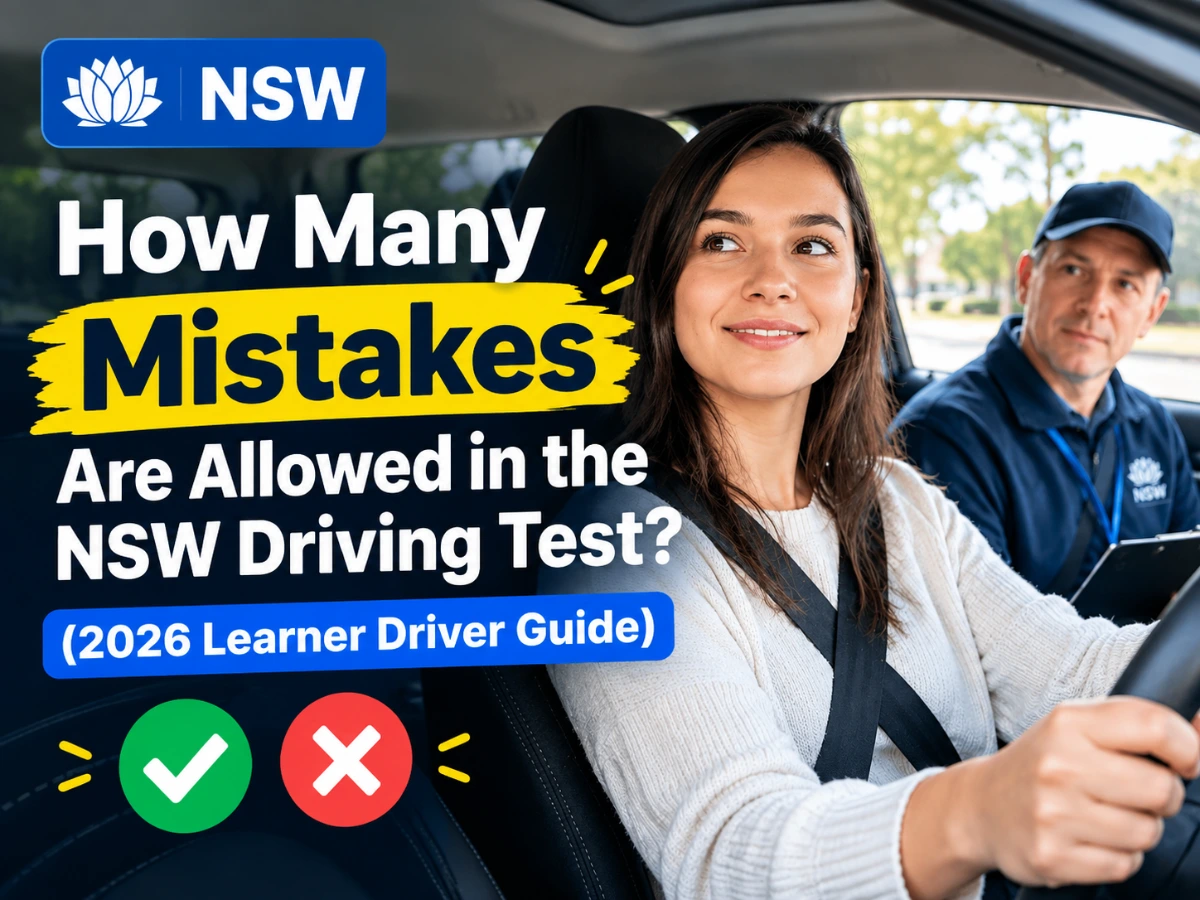
Every learner driver asks the same question before the big day: how many mistakes can I make and still pass? We hear it all the time, and the short answer is that you can make a few small errors, but you cannot make a critical one.
In this guide, we explain how the NSW driving test is scored, which errors fail you straight away, and how to avoid the most common mistakes. We also share practical tips from our work with learners across Sydney, so you walk into the test centre feeling ready.
How Many Mistakes Can You Make in the NSW Driving Test?
You can make some minor errors and still pass. You cannot make a critical error. That is the core rule.
The NSW driving test follows a set course made up of 25 zones. The examiner marks your performance on a score sheet as you drive. To pass, you need to score at least 90 per cent and have no fail items.
So the number of mistakes allowed depends on two things:
- Your total score. Small slips, like a late signal or a wide turn, take marks off your score.
- Your fail items. Serious errors, like failing to give way, cause an automatic fail no matter how well the rest of your drive goes.
This means one big mistake can cost you more than ten small ones. We always tell our learners to focus on safe driving first and polish the details second.
How the NSW Driving Test Score Works
The examiner sits beside you with a score sheet and records what you do in each zone of the route. Small errors reduce your score. Fail items and critical errors sit in a separate section, and a single mark there ends your chance of passing.
Here is how we explain it to learners:
- Minor errors are small slips that do not put anyone at risk. Examples include a slightly late signal, a rough gear change, or sitting a little wide in your lane.
- Critical errors are actions that create a danger for you or other road users. The examiner may stop the test early.
- Your final score is the percentage of marks you keep across all the zones, as long as you have no fail items.
The test is meant to show that you can drive safely and legally on a normal NSW road. It is not a trick. Examiners want to see calm, predictable driving that other road users can read easily.
If you want to see how the score sheet works in practice, ask your driving instructor to mark you the same way during a mock test. It makes the real thing far less scary.
What Is a Critical Error in the NSW Driving Test?
A critical error is any action that makes the examiner or another road user unsafe. Most critical errors fall into a few groups. Each one could be a critical error on its own, so none of them are worth risking.
- Failing to give way. This is the most common reason learners fail. It includes cutting off a car at an intersection or not yielding to a pedestrian.
- Not stopping at a stop sign. A rolling stop counts as a fail. You must come to a complete stop behind the line.
- Speeding or driving significantly under the limit. Going over the limit in a school zone is serious. Driving well below the limit and holding up traffic can also cost you.
- Running a red light or ignoring a traffic sign.
- Mounting the kerb or hitting the kerb hard. A light touch while parking may only lose marks, but mounting the kerb is a safety concern.
- Examiner intervention. If the examiner has to grab the wheel, use the brake or give an urgent instruction, the test usually ends.
- Unsafe lane changes. Moving over without checking your blind spot can put a cyclist or another driver at risk.
You can read more about the patterns we see in our post on the top 10 reasons learners fail their driving test in NSW and how to avoid them.
Common Mistakes at Intersections and Roundabouts
Intersections and roundabouts cause more trouble than any other part of the test. We see the same errors again and again.
At an intersection, we often see learners:
- Pull out when there is not enough space
- Fail to give way when turning right
- Stop too far over the line and block the crossing
- Forget to check for pedestrians before turning
At a roundabout, we often see learners:
- Choose the wrong lane before entering
- Forget to signal when exiting
- Fail to give way to vehicles already in the roundabout
- Enter too fast without checking the traffic flow
The fix is simple. Slow down early, scan left, right, and ahead, and make your decision based on what you can see. If you are not sure, wait. A short pause costs you nothing, but pulling out at the wrong time could fail the test.
Signal, Speed Limits and Stop Sign Errors
Small habits add up. These three areas catch out many learners who are otherwise good drivers.
Signals. Indicate early enough for other road users to react. Cancel your signal once you finish the turn. Do not signal too late or leave it on by mistake.
Speed limits. Know the limit on every NSW road you drive and watch for changes. School zones are a big one. Check the signs and slow down well before you enter. Many learners also lose marks by driving too slowly, so aim to match the flow of traffic when it is safe.
Stop signs. Stop fully, with the car still for a moment, and stop behind the line. Then check both ways before you move off. If you want a full list of what to bring and what to check on the day, see our NSW driving test checklist.
Poor Observation Skills: The Silent Test Killer
Poor observation skills sit behind many of the errors above. Examiners watch your eyes and your head movements closely, because they show whether you really see what is happening around you.
Here is what good observation looks like:
- Check your mirrors often and before every change in speed or direction
- Do a quick head check over your shoulder before you change lanes or move off from the kerb
- Scan left and right at every intersection, even when you have right of way
- Look well down the road ahead to identify potential hazards early
- Keep your eyes moving instead of staring at the car in front
A blind spot check is not optional. If you skip it and a cyclist is beside you, that is a critical error. Make your head movements clear so the examiner can see them. Thoroughly scanning left and right is a habit, and habits come from practice.
Following Distances and Other Road Users
Keeping a safe gap shows the examiner that you can handle heavy traffic and sudden stops. Stay at least three seconds behind the vehicle in front in good conditions, and leave more space when it is wet.
Beyond cars, watch for:
- Cyclists. Give them room and check for them before you turn or open your door.
- Pedestrians. Be aware of pedestrians near crossings, bus stops, and school zones.
- Buses and trucks. They take longer to stop and need more room to turn.
Maintaining a safe following distance also gives you time to brake smoothly. If you have to slam the brakes, it usually means you were too close.
Manoeuvres: Reverse Parallel Park and Three-Point Turn
Specific manoeuvres can lower your score even when your driving is solid. The two we see most are the reverse parallel park and the three-point turn.
Reverse parallel park. Take your time. Check your mirrors and blind spot, signal, and reverse slowly. You can lose marks for hitting the kerb, finishing too far from the kerb or taking too many attempts. Gentle contact with the kerb may only cost marks, but mounting it is a bigger problem.
Three-point turn. Pick a safe spot with a clear view in both directions. Check for traffic each time you move and use the whole width of the road if you need it. Do not rush, and do not swing the wheel in jerky movements.
Both manoeuvres need practice, not luck. Do each of them at least 15 to 20 times with your instructor before test day. Hours add up, and our guide on how many hours of driving lessons you need before your test can help you plan.
Smooth Control Matters Too
Examiners like drivers who are smooth and controlled. You do not need to drive like a racing driver. You need steady steering inputs, smooth acceleration, and gentle braking.
Watch out for these habits:
- Jerky movements when you start or stop
- Swerve or drift when you change lanes
- Late, harsh braking
- Wide or tight corners
If you drive a manual, stalling does not always fail you, but repeated stalls add up and can make you nervous. If you are still deciding between the two, our article on manual vs automatic and which to learn first in Sydney can help.
What Happens If You Fail the NSW Driving Test?
First, take a breath. Many learners fail the test, and it does not mean you cannot drive. Your examiner will explain why you did not pass. Use that feedback.
Ask yourself:
- Was it a single critical error or a few small ones?
- Was it nerves, or did you not know a road rule?
- Which part of the route felt shaky?
You will need to rebook your test and wait before you can sit it again. Check the current wait time and fee on the Transport for NSW website. While you wait, book a few driving lessons that target your weak spots. If it has been a while since you drove, a refresher driving lesson in Sydney can bring your confidence back.
How to Get Ready to Pass
You will not pass by luck. The right preparation and practice make the difference. Here is the path we recommend to every learner driver.
1. Pass the early steps. You start with the NSW DKT (Driver Knowledge Test) to get your learner licence. Before you can sit the driving test, you also need to pass the Hazard Perception Test.
2. Log your hours. In NSW, you generally need 120 hours behind the wheel, including 20 hours of night driving, and at least 12 months on your Ls. Night practice is worth the effort. Our night driving lessons guide for Sydney learners shows how to build confidence after dark.
3. Practise the test conditions. Drive in residential areas, busy main roads, and school zones. Practise at different times of day so you can handle heavy traffic and changing road conditions.
4. Book lessons with a driving school that knows the area. An instructor who knows your local test centre can run you through the same type of roads you will face. If you live in the west, our Parramatta driving school page explains how lessons work there. Some learners also feel more relaxed with a particular type of instructor, and we cover that in our post on why some learners prefer a female driving instructor in Sydney.
5. Do a mock test. Ask your instructor to mark you like a real examiner. A mock test at Licence Help or any good driving school shows you exactly where you lose marks, so you can fix them before the real exam.
6. Prepare for test day. Get a good night of sleep, arrive early, bring everything you need and check that your car is roadworthy.
You Are One Step Closer
The NSW driving test is not about being perfect. It is about showing the examiner that you drive safely, follow every road rule and make good decisions around other road users. Small slips will not sink you, but critical errors will, so we recommend putting most of your effort into observation, giving way and speed control.
With the right preparation, many learners can walk into the test centre feeling calm and ready to pass. If you want help getting there, our team at Licence Help is here to support you from your first lesson to test day.
Related Topics
Ready to Pass Your Test? Book Your First Lesson Today
Ready to Pass Your Test? Book Your First Lesson Today
Your Road to Safe Driving Start Here
Thousands of Melbourne learners have trusted Licence Pass to help them pass their test and become safe, independent drivers. Here’s what sets us apart.
Frequently Asked Questions
Got questions before you book your first lesson? Here’s what Sydney learners ask us most.
How long should I practice before the test?
Log the full 120 hours, then keep practising until you drive safely and smoothly without help.
Do I need a driving instructor to pass?
You do not have to use one, but most learners who pass the first time have had professional lessons. A good instructor spots habits that family and friends often miss.
Can you fail for hitting the kerb?
A light touch may only lose marks. Mounting the kerb or hitting it hard can count as a critical error.
What automatically fails you in the NSW driving test?
Critical errors do. Common ones include failing to give way, not stopping at a stop sign, speeding, running a red light, and unsafe lane changes.
What is the pass mark for the NSW driving test?
You need at least 90 per cent with no fail items. The test follows a set course of 25 zones.
Tips & Advice for Sydney Learner Drivers
Practical advice from certified instructors to help you prepare for lessons, get test-ready and become a safer, more confident driver on Sydney roads.
How the 120-Hour Logbook Works in NSW
If you are a learner driver in NSW, the 120-hour logbook is probably the biggest…
How Many Lessons Do I Need to Pass a Manual Driving Test?
Most learners ask us the same thing before they book their first lesson: how many…
Driving Lessons for Anxious Drivers in Sydney: What to Expect in Your First Session
Your first driving lesson as an anxious driver should feel nothing like the stressful experience…