
+92306 3026 466
How to Reverse Parallel Park in Sydney for Your Driving Test
Book Your Lesson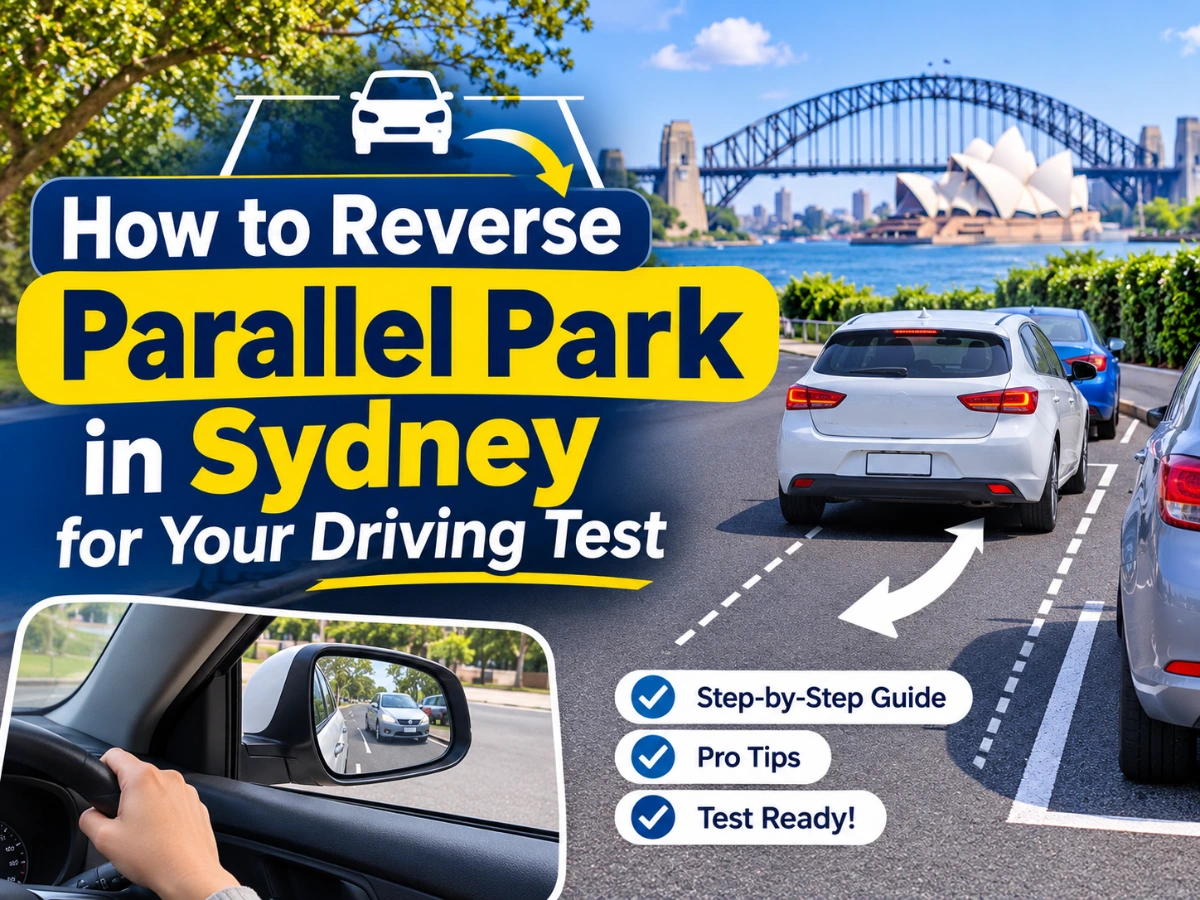
To parallel park in Sydney, signal and line up beside the car ahead, check your surroundings, reverse slowly towards the kerb, then straighten and adjust until you’re parallel. It’s one of the most dreaded skills for learner drivers, and narrow streets in Surry Hills, packed strips in Bondi Junction and busy shopping centres around Parramatta can make a normal gap look tiny.
Here’s the reassuring part: parallel parking is a repeatable routine. Once you know the steps and practise them slowly, it stops feeling like guesswork. This guide covers the steps, the usual mistakes and how to stay calm when someone is waiting behind you.
How to Reverse Parallel Park Step by Step
Pull up beside the car in front, check your mirrors and blind spot, reverse slowly while steering towards the kerb, straighten the wheels as your car lines up, then adjust until you’re parallel to the kerb.
Here’s the full process, using a space on the left:
The car in front of the gap is the one you’ll park behind, so use it to judge your starting position before reversing.
Step 1: Find a Suitable Gap
Look for a space about one and a half times the length of your car. Check the signs first. Time limits, permit zones, loading zones and bus zones are common around Sydney, and the road rules shown on the signs determine where and when you can park.
Step 2: Signal and Line Up
Indicate left and stop alongside the car in front of the space. Leave about one metre between the two cars and line up your rear bumpers, so you’re positioned to park behind that car.
Step 3: Check Your Mirrors and Blind Spot
Check the mirrors, then look over your shoulder. Watch for traffic, cyclists and pedestrians before you move.
Step 4: Reverse Slowly and Steer Towards the Kerb
Select reverse and let the car creep back. Turn the steering wheel towards the kerb. Keep your speed as low as you can, making this manoeuvre slowly and with control.
Step 5: Straighten Up
Once your car is at roughly a 45-degree angle, start turning the wheel the other way. This swings the front of the car into the space. Keep checking your mirrors and the front corner of your car.
Step 6: Adjust Your Position
Stop when you’re parallel to the kerb. If you’re too far out or too close to the car in front, pull forward and adjust. Small corrections are normal and perfectly safe.
Step 7: Secure the Car
Apply the handbrake, switch the engine off and check for cyclists and passing traffic before you open your door.
Why Is Parallel Parking So Hard for Learners?
It combines several skills at once: judging distance, steering in the opposite direction to what feels natural, checking mirrors and watching traffic, often while other drivers are waiting. That makes the manoeuvre feel demanding until the steps become familiar.
Most nervous learners find it hard for the same few reasons:
- Reversing feels less natural than driving forward
- It’s hard to judge the gap and the angle by eye
- Pressure from traffic behind makes people rush
- Fear of touching another car or the kerb
The good news is that each of these improves with slow, repeated practice. Building confidence with parking is an essential skill that develops one careful attempt at a time.
What Are the NSW Parallel Parking Rules and Driving Test Requirements?
Check the parking signs, make sure the gap is big enough and avoid restricted areas such as fire hydrants, bus zones and spots too close to an intersection.
A quick checklist before you commit:
- Read every sign: Look at the time limits, permit zones and clearway times.
- Check the length: Make sure you have enough room front and back.
- Look for restricted spots: Driveways, hydrants, bus zones, loading zones and intersections are all areas where parking rules apply.
- Scan for people: Cyclists, pedestrians and car doors opening nearby.
Parking rules and distances can vary and change, so always follow the signs on the street and check the latest information from Transport for NSW or your local council.
How Close Should You Park to the Kerb?
As close as you can safely get while keeping your car straight and parallel, without touching or scraping the kerb.
A good aim is to finish with your car sitting neatly parallel, with your wheels straight and your tyres a short, even distance from the kerb. If you end up crooked or too wide, pull out and fix it. A second attempt is better than leaving your car at an angle.
What Are Common Parallel Parking Mistakes and How Can You Fix Them?
Common parallel parking mistakes include reversing too fast, starting too far from the parked car, turning the wheel at the wrong time and forgetting the blind spot check.
| Mistake | Why it happens | Easy fix |
|---|---|---|
| Reversing too fast | Nerves and pressure from traffic | Slow down and use light brake or clutch control |
| Starting too far from the parked car | Unsure of the right position | Stay about one metre away and line up your bumpers |
| Turning the wheel too early or late | No clear reference point | Practise the same timing until it feels natural |
| Skipping the shoulder check | Relying only on mirrors | Always look over your shoulder before moving |
| Ending up too far from the kerb | Giving up after one attempt | Pull forward and adjust |
How to Build Confidence Practising Parallel Parking
Slow right down, breathe, and treat each attempt as practice. Safe driving always matters more than speed.
Some practical ways to settle your nerves:
- Practise in a quiet street first: Pick somewhere with few cars and no time pressure.
- Use markers: Two bins or cones about six metres apart let you practise without the fear of hitting a real car.
- Don’t rush for other drivers: A clear indicator is enough to show your intention. Take the time you need.
- Reset if it goes wrong: Pull out, straighten up and start again.
- Learn your car’s reference points: Lining up part of your mirror or window with the kerb or another car’s bumper is far more reliable than guessing. These points differ from car to car, so ask your instructor to show you the ones that suit your vehicle.
Is Parallel Parking Different in an Automatic and a Manual Car?
The steps are the same. The main difference is speed control. Automatics use the brake alone, while manuals also use the clutch’s biting point.
In an automatic, you can creep back with light pressure on the brake, which many nervous learners find simpler. In a manual, the clutch gives you very fine control once you’ve got a feel for it, but it takes a bit more practice at the start.
If you’re still deciding which to learn in, Licence Help offers both automatic driving lessons and manual driving lessons in Sydney, including a focused parking lesson.
How Long Does It Take to Learn Parallel Parking?
It depends on the learner. Many people feel noticeably more confident after a few focused practice sessions, especially with an instructor from a driving school guiding them.
Progress is rarely a straight line. You may nail it one day and struggle the next, and that’s normal. Short, regular parking practice usually works better than one long session.
When Should You Get Help From a Driving Instructor?
If you keep feeling stuck, anxious or unsure about your angles, a patient instructor can spot what’s going wrong much faster than self-practice.
A good instructor can show you reference points for your specific car, watch your timing and correct small habits before they stick. Licence Help is led by a certified, police-checked instructor with over 32 years of experience, and our nervous driver lessons are built around patience and your pace, not pressure.
If you’d like help with parking and everything else that comes with learning to drive in Sydney, you can book a lesson online or call 1300 350 600.
Related Topics
Ready to Pass Your Test? Book Your First Lesson Today
Ready to Pass Your Test? Book Your First Lesson Today
Your Road to Safe Driving Start Here
Thousands of Melbourne learners have trusted Licence Pass to help them pass their test and become safe, independent drivers. Here’s what sets us apart.
Frequently Asked Questions
Got questions before you book your first lesson? Here’s what Sydney learners ask us most.
Do nervous learners need extra lessons for parking?
Not always, but extra practice with an instructor can help a lot. Many nervous learners find parking easier once someone explains the angles and reference points for their car.
Can I practise parallel parking without other cars?
Yes. Use two cones, bins or even large boxes set about six metres apart in an empty car park or quiet street.
Should I park close to the kerb?
Yes, as close as you can while staying safe and straight. Avoid scraping tyres or rims against the kerb.
Is it okay to take more than one attempt?
Yes. Adjusting your position is part of safe parking, and it’s better than forcing a poor angle.
What if I hit the kerb while parking?
Stop, pull forward and try again. It’s common while learning, and checking where your wheels ended up helps you adjust next time.
Tips & Advice for Sydney Learner Drivers
Practical advice from certified instructors to help you prepare for lessons, get test-ready and become a safer, more confident driver on Sydney roads.

Car Hire for Driving Test in Sydney: Own Car or Hire?
For a NSW driving test in Sydney, you can use your own registered, roadworthy car…
NSW Hazard Perception Test (HPT): How It Works and Tips to Pass
The hazard perception test NSW learners sit is a short, touchscreen, video-based test that you…
How to Choose the Right Driving Instructor in Sydney (7 Questions to Ask)
Choosing a driving instructor feels like a small decision until you’re sitting beside a stranger,…