
+92306 3026 466
Top 10 Reasons Learners Fail Their Driving Test in NSW (And How to Avoid Them)
Book Your Lesson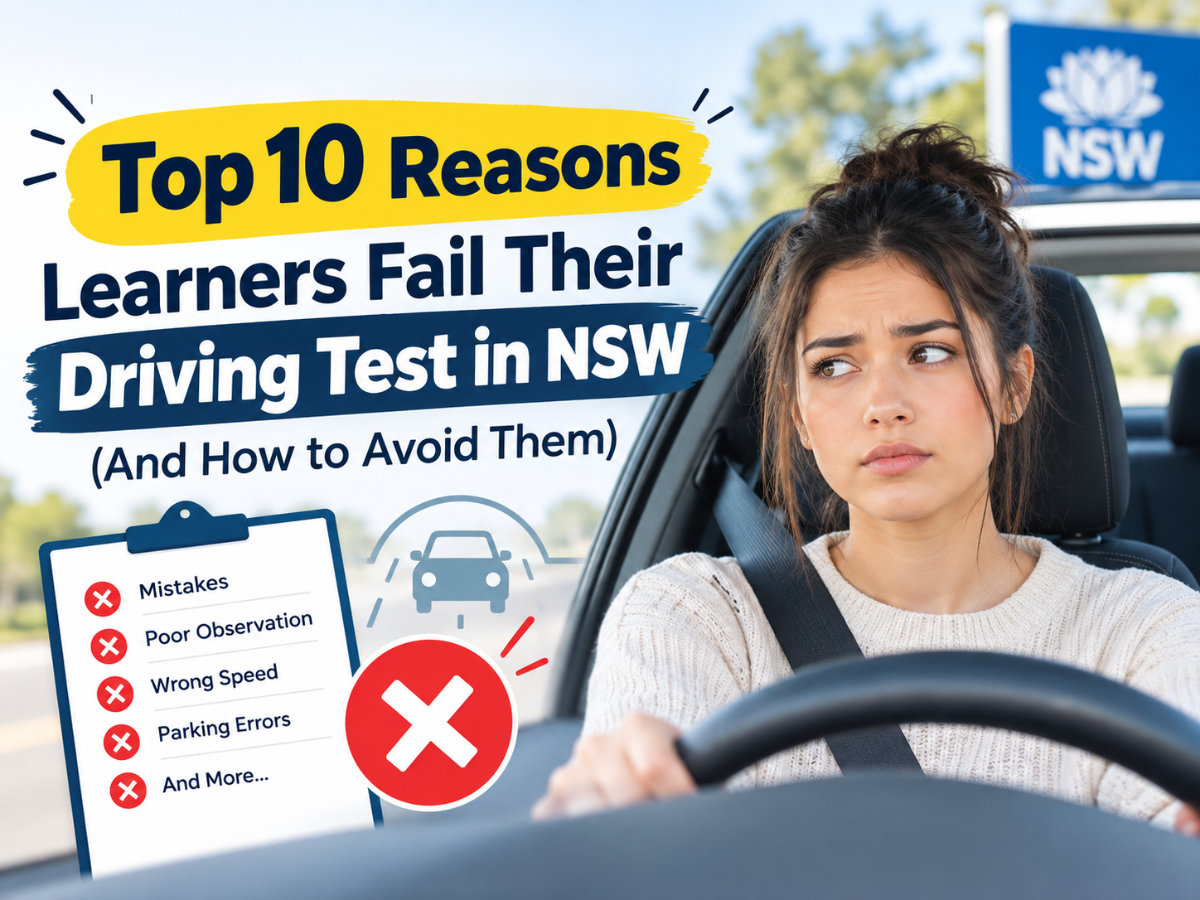
Nearly half of all learner drivers don’t pass their NSW driving test on the first attempt, and it’s rarely because of one dramatic mistake. Most fails come down to small, avoidable habits, missed head checks, rolling through stop signs, poor gap selection, and weak speed control. The good news is that once you know what examiners are actually watching for, most of these are easy to fix with focused practice.
If you’re prepping for your test, it helps to know exactly where other learners trip up. Here are the top 10 reasons drivers fail their NSW driving test, and what you can do differently to avoid the same mistakes.
The 10 Most Common Reasons Learners Fail
- Missing head checks (blind spot checks)
- Rolling through stop signs
- Failing to give way
- Poor speed management
- Weak mirror habits
- Incorrect or late indicator use
- Poor gap selection at intersections and roundabouts
- Roundabout exit signalling errors
- Poor parking technique
- Being under-prepared or testing too soon
Now let’s break each one down, along with exactly how to fix it.
1. Missing Head Checks (Blind Spot Checks)
Forgetting to physically turn your head and check your blind spot is the single most common reason learners fail the NSW driving test.
A quick glance in the mirror isn’t enough examiners need to see your head actually turn before you change lanes, merge, or pull away from the kerb. You’re allowed a couple of head check slip-ups during the test, but a third one usually means an instant fail.
How to fix it: Make the head turn obvious, every single time, even when the road looks clear. It should feel almost exaggerated at first that’s normal, and it becomes natural with practice.
2. Rolling Through Stop Signs
Slowing down at a stop sign without fully stopping is treated as an instant fail, no matter how slow you were going.
This one catches out a lot of learners because it feels like you’ve “basically stopped.” But NSW examiners are strict here, your wheels need to come to a complete standstill.
How to fix it: Count “one-one-thousand” once you’ve stopped, before moving off again. It sounds simple, but it removes any doubt about whether you actually stopped.
3. Failing to Give Way
Not giving way correctly at intersections, roundabouts, or to pedestrians is one of the most serious and common fail points.
Whether it’s misjudging who has right of way at an intersection or not stopping fully for a pedestrian, give-way errors are treated seriously because they directly affect road safety.
How to fix it: Practice give-way rules specifically at T-intersections, roundabouts, and pedestrian crossings, since these are the situations where hesitation or misjudgement happens most.
4. Poor Speed Management
Driving too fast is an instant fail, but driving too slowly and holding up traffic also costs you marks.
Speed management isn’t just about staying under the limit, it’s about matching your speed to the conditions. This is especially relevant in school zones, where failing to drop to 40km/h during active hours is a common and completely avoidable fail.
How to fix it: Know the speed limits along your practice routes properly, including school zone timing, and aim to sit right at the limit rather than noticeably under it.
5. Weak Mirror Habits
Not checking your mirrors often enough or not making it obvious that you’re checking is an easy way to lose marks throughout the test.
Examiners want to see consistent, visible mirror checks roughly every 5 to 8 seconds, not just before you make a manoeuvre.
How to fix it: Build a habit of checking mirrors on a rhythm, not just reactively. It should become something you do automatically, regardless of what’s happening on the road.
6. Incorrect or Late Indicator Use
Signalling too late, forgetting to signal, or leaving your indicator on after a turn are all common and avoidable errors.
Your indicators are how you communicate with everyone else on the road, including the examiner. Getting the timing wrong even by a few seconds can look like poor awareness.
How to fix it: Indicate at least 5 seconds before changing lanes or turning and get into the habit of checking your indicator has switched off after you’ve completed the manoeuvre.
7. Poor Gap Selection at Intersections and Roundabouts
Being either too hesitant or too risky when choosing a gap in traffic is one of the more nuanced fail points learners struggle with.
Waiting too long for a “perfect” gap can hold up traffic and suggest a lack of confidence, while pulling out into a gap that’s genuinely too small is a safety risk.
How to fix it: Practice gap judgement in quieter areas first, then gradually build up to busier roads as your confidence grows.
8. Roundabout Exit Signalling Errors
Forgetting to indicate left when exiting a roundabout is a small but frequent mistake that catches learners off guard.
It’s easy to focus so much on entering a roundabout correctly that exiting safely gets forgotten but examiners are watching this just as closely.
How to fix it: As soon as you pass the exit before the one you want, flick your left indicator on. Practising this as a fixed habit removes the guesswork.
9. Poor Parking Technique
Reverse parking and kerbside stops are core parts of the test, and rushing or misjudging them is a common reason for losing marks.
Parking mistakes often happen because learners rush, especially if they’re feeling nervous about the rest of the test.
How to fix it: Practice reverse parking and kerbside stops specifically and repeatedly, rather than treating them as a minor afterthought in your lessons.
10. Being Under-Prepared or Testing Too Soon
Booking your test before you’re genuinely ready is one of the most common and most avoidable reasons for failing.
It’s tempting to book as soon as you’re eligible but rushing in before you’re truly comfortable often means repeating avoidable mistakes under pressure.
How to fix it: Take your instructor’s feedback seriously, if they’re flagging the same issue across a few lessons, it’s worth addressing before you book, not after you fail.
NSW Driving Test Tips: A Few Extra Habits That Help
Beyond fixing individual mistakes, a few broader habits make a real difference on test day staying calm, knowing your test centre, and practising under realistic conditions.
A few extra things worth keeping in mind:
- Practice in a range of conditions: Urban streets, quiet residential roads, and roundabout-heavy areas
- Stay calm after a small mistake: One minor error rarely fails you on its own
- Know your test centre’s common routes: Ask your instructor what areas your local centre tends to use
- Simulate real test conditions: A mock test with your instructor can reveal habits you don’t notice yourself
Common Mistakes in Driving Tests Aren’t Just an NSW Problem
While this list is specific to NSW, head checks, mirror habits, and speed management are the top three fail reasons in almost every Australian state.
If there’s one thing worth taking from this list, it’s that the same handful of habits proper observation, controlled speed, and confident gap selection make the biggest difference, wherever you’re testing.
How Licence Help Can Help You Avoid These Mistakes
An experienced instructor can spot these patterns early, often before you’re even aware you’re doing them.
Many of the mistakes on this list are hard to notice in yourself that’s exactly what a second pair of eyes is for. Licence Help’s driving lessons in Sydney are built around identifying these habits early, with an instructor who knows exactly what NSW examiners are looking for. If you’re getting close to test day, it’s also worth reading our NSW driving test checklist to make sure the paperwork side is sorted too.
Book a Lesson to Iron Out These Habits Before Test Day
A focused lesson before your test can help you catch and correct these common mistakes while there’s still time.
Whether it’s a head check habit you keep forgetting or gap selection that still feels shaky, a few targeted lessons can make a real difference.
Book your driving lesson with Licence Help today and head into your test with these common mistakes already sorted.
Related Topics
Ready to Pass Your Test? Book Your First Lesson Today
Ready to Pass Your Test? Book Your First Lesson Today
Your Road to Safe Driving Start Here
Thousands of Melbourne learners have trusted Licence Pass to help them pass their test and become safe, independent drivers. Here’s what sets us apart.
Frequently Asked Questions
Got questions before you book your first lesson? Here’s what Sydney learners ask us most.
Should I book my driving test as soon as I’m eligible?
Not necessarily. Booking before you’re genuinely confident behind the wheel is one of the most common reasons for failing, so it’s worth waiting until your driving school or instructor confirms you’re ready. It’s natural to feel nervous, but a solo driving session or two, alongside a proper practice test, can help you feel confident enough to complete the test calmly. Take a deep breath, focus on the areas that need improving, follow the road rules, and remember: practice makes perfect on the road to getting your driver’s licence.
Does using my phone during the test cause an immediate fail?
Yes. Touching or even glancing at your phone at the test centre is treated as an immediate fail, so it’s best to switch it off completely before you start driving. Small lapses in focus like this are a surprisingly common mistake among otherwise skilled learner drivers.
What percentage of learners pass the driving test on their first attempt?
Recent test pass rates suggest roughly half of learner drivers don’t pass on their driving test on the first attempt, and most failures come down to observation, speed, and gap selection rather than major errors. Learners often underestimate how much staying aware of your surroundings matters in everyday traffic situations, from school zones to busy roundabouts.
Can a driving instructor help reduce my chances of failing?
Yes. An experienced driving instructor can spot driving habits like weak mirror checks, poor gap selection, or hesitant parallel parking that are hard to notice in yourself and help you understand exactly which skills need work before you book driving test day. Regular practice tests under real test conditions not just casual driving lessons will help you pass and build genuine driving experience behind the wheel.
How many mistakes are you allowed to make on the driving test?
You’re allowed a number of non-critical errors throughout the test, a bit of jerky braking or slightly late signalling usually won’t fail you outright. But one critical error, such as failing to give way, signalling too late, or drifting into the wrong lane on a multi-lane road, can result in an immediate fail. Understanding this distinction is one of the biggest areas that need attention during driving test preparation, since many learners fail simply because they don’t know where the line is.
Tips & Advice for Sydney Learner Drivers
Practical advice from certified instructors to help you prepare for lessons, get test-ready and become a safer, more confident driver on Sydney roads.

Why Some Learners Prefer a Female Driving Instructor in Sydney
Many learners prefer a female driving instructor because it simply feels more comfortable, especially for…
NSW Driving Test Checklist: Everything You Need on Test Day
For your NSW driving test, you’ll need a valid learner licence card, proof of your…

Night Driving Lessons in Sydney: A Learner’s Guide to Becoming a Confident Night-Time Driver
Yes, night driving is safe for learners, and in NSW it’s actually required. Learner drivers…